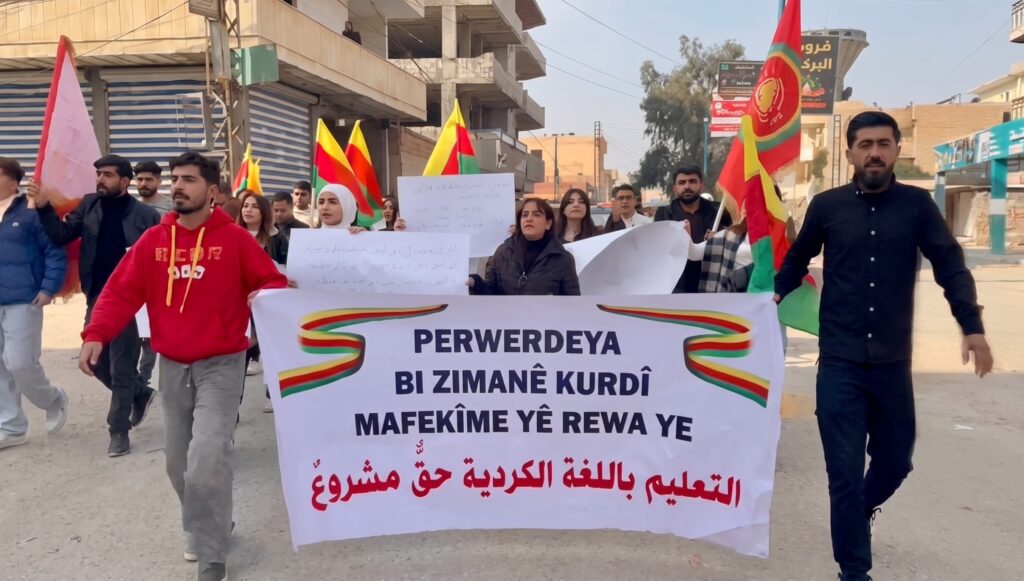
On November 16, 2026, armed security forces entered the main campus of Rojava University in Qamishli and fired tear gas at peaceful student protesters, injuring approximately 25 young men and women, according to student accounts reported by Rudaw. The students had gathered to block the departure of a joint integration delegation after officials refused to leave their vehicles to hear the students’ demands about the future of their institution.
“They did not even get out of their vehicles to meet us. That is why they injured us,” Kajiyan Mihemed, an injured second-year geography student, said following the confrontation. “We want our language, Kurdish. We do not want our university to be closed or transferred to Deir ez-Zor, Aleppo, or Damascus. We want our university to remain here.”
In a statement released later that day and shared with the author, Rojava University condemned the incident as a “flagrant violation of all university conventions and laws that guarantee freedom of expression and protect the sanctity of educational institutions from armed forces.”
On November 17, Rudaw also reported that the United Nations had publicly supported the right to peaceful protest following the Qamishli incident. That support underscores the basic principle at stake: Students must be able to express their concerns and defend their educational rights without facing violence or intimidation.
For those closely monitoring Syria’s fragile transition, tear gas over the campus of Rojava University, the premier institution of Kurdish higher education in Syria, was not entirely unexpected. It is the consequence of a constitutional contradiction that the government in Damascus has refused to resolve, and a warning for every minority community in post-Assad Syria.
The Kurds are Syria’s largest non-Arab ethnic minority, comprising approximately 15 to 20 percent of the country’s population. They are a distinct people with their own language, identity, and history. Under successive Syrian governments, including decades of Baath Party rule from 1963 to 2024, Kurds faced systematic discrimination. The 1962 Hasakah census stripped approximately 120,000 Kurds of Syrian citizenship, creating a stateless population whose numbers grew over subsequent generations. Kurdish was excluded from formal education and subjected to extensive restrictions in public and cultural life. The fall of the Assad government offered a historic opportunity to build a more pluralistic state.
The March 10, 2025 agreement between interim President Ahmad al-Sharaa and Syrian Democratic Forces (SDF) Commander Mazloum Abdi committed both sides to integrating the civil and military institutions of the Kurdish-led administration in northeast Syria into the Syrian state. A follow-up integration agreement finalized at the end of January 2026 included Article 11, which addressed recognition of diplomas issued under the region’s education system. That system, established in 2012, provided mother-tongue instruction in Kurdish and Arabic, as well as Syriac for Syriac and Assyrian communities.
In practice, however, integration has increasingly meant dismantling existing Kurdish institutions rather than addressing decades of statelessness and linguistic suppression.
Analysts, including this author, warned in May 2026 that leaving Kurdish linguistic rights dependent on reversible executive decrees, rather than enshrining Kurdish as an official language in the permanent constitution, would invite a rollback of Kurdish education. Subsequent developments have reinforced those concerns.
In January 2026, al-Sharaa issued Presidential Decree No. 13, recognizing Kurdish as a national language and permitting its teaching in schools in areas with significant Kurdish populations. Yet the decree did not establish Kurdish as an official state language or amend Article 4 of the interim constitutional declaration, which designates Arabic as the official language. Nor did it guarantee Kurdish as a language of instruction throughout the education system. Its protections therefore remained limited and vulnerable to subsequent administrative restrictions.
Ahead of the 2026–2027 academic year, the Ministry of Education issued implementing instructions on August 27, 2026, under Decision No. 2068/943, limiting Kurdish-language instruction to three weekly class periods, alongside an additional activity period. Although Kurdish was formally introduced into the state curriculum and its grades were included in students’ overall averages, the measure did not preserve the Kurdish-medium educational system that had operated in the region since 2012.
Officials have framed such measures as necessary to apply unified national standards and integrate regional curricula. Reducing a primary language of instruction to three weekly periods while replacing the broader Kurdish-medium system represents a profound demotion in practice, whatever the stated intent.
As the Teachers’ Union of North and East Syria (UTNES) stressed when educators gathered outside the Education Directorate in Hasakah on August 30, the restrictions undermine students’ ability to read, write, and study in their mother tongue while threatening the livelihoods and professional expertise of thousands of teachers.
International labor groups quickly echoed that alarm. On September 8, Education International, the global federation representing more than 32 million educators, sent a formal protest letter to Syrian Minister of Education Dr. Mohammed Abdul Rahman Turko. General Secretary David Edwards described mother-tongue education as a fundamental right essential to UN Sustainable Development Goal 4 and urged “meaningful social dialogue” with UTNES rather than unilateral decrees.
A generation of Kurdish students educated in their mother tongue over the past fourteen years will not quietly accept a return to forced assimilation. Students who have spent seven or eight years studying mathematics, science, and literature in Kurdish now face an abrupt shift to an Arabic-language curriculum, creating a pedagogical shock and a direct threat to their educational futures.
Beginning in September and continuing through November, hundreds of Kurdish students across multiple cities took to the streets. From Kobane in the west to Qamishli, Hasakah, Derik, Girkê Legê, and Rimelan in the east, they staged peaceful marches, persisting even after masked assailants attacked protesting students in Hasakah in early November. Demonstrators in Qamishli were explicit that they seek “natural and legitimate rights,” not special privileges.
This youth mobilization is matched by organized, non-partisan civil society. On October 17, 2026, independent academics, educators, and civic leaders in Qamishli launched the Initiative for the Constitutional Recognition and Official Status of the Kurdish Language in Syria. Grounded in the Universal Declaration of Human Rights, the Convention on the Rights of the Child, UNESCO standards on mother-tongue education, and the European Charter for Regional or Minority Languages, the initiative outlined a legal roadmap: documenting educational conditions, drafting legislative proposals, and submitting formal recommendations to the bodies writing Syria’s permanent constitution.
Appealing to UNESCO and UNICEF for technical support, its founding declaration, published on October 17 through the Kurdish Committee for Human Rights, states: “Linguistic equality does not diminish anyone, and cultural diversity is not a threat to the unity of the state.”
These restrictions on Kurdish-language instruction point to a wider restructuring aimed at the very institutions responsible for producing, preserving, and advancing Kurdish scholarship and higher education in Syria, above all Rojava University.
Established in 2016, Rojava University stands as a historic milestone as the first institution of higher learning in Syria to teach and produce academic scholarship in Kurdish alongside Arabic and Syriac. Over the past decade, it has grown into a vital, multidisciplinary university that has standardized modern Kurdish academic curricula and trained thousands of professionals across the diverse communities of northeast Syria. Supported by an international network of visiting and collaborating faculty from the United States, Europe, Canada, and elsewhere, the university has built academic partnerships beyond Syria. Through its academic programs and international collaborations, it has developed institutional capacity and educational expertise that must be preserved and respected within any national higher education framework. Rojava University represents an invaluable academic, cultural, and linguistic asset capable of offering genuine insight into the history, literature, and lived reality of Syria’s Kurdish population.
Rather than recognizing Rojava University as an autonomous, accredited institution in its own right and engaging with its leadership and academic community to develop a mutually acceptable framework, authorities in Damascus have proposed restructuring the institution as a “Qamishli Colleges Complex,” with temporary affiliation to state-run Al-Furat University, headquartered in Deir ez-Zor, and the prospect of eventual affiliation with a planned Hasakah University. The proposal would effectively erase Rojava University’s name, institutional independence, and academic identity.
Placing an established university in Qamishli under the temporary authority of an institution based in Deir ez-Zor makes little geographic, linguistic, or academic sense. For decades under Baathist rule, Damascus denied Hasakah province its own independent university, forcing local students to travel to distant cities such as Aleppo, Damascus, or Deir ez-Zor for higher education. Subordinating Rojava University to an institution in Deir ez-Zor, under a promise of establishing a state-run Hasakah University at an unspecified future date, risks reviving that legacy of marginalization.
At the same time, the Ministry of Higher Education has refused to accredit several of Rojava University’s core faculties, including medicine, engineering, political science, philosophy, and arts, halting new admissions and requiring students in unaccredited programs to relocate to Damascus or other governorates to complete their studies. To students and faculty, sending young people hundreds of kilometers away from their families during severe economic hardship while stripping away core disciplines, institutional independence, and the university’s Kurdish character amounts to liquidating their university from within. As student representative Nasrin Muhammad declared after the campus assault: “An integration in which our rights do not exist, we will never accept such integration.”
The broader political consequences are already visible. The Kurdish-led administration agreed to integrate on the premise that its institutions and identity would be protected. When that premise erodes, the case for integration weakens among the very communities Damascus needs to bring into the state.
Even after Mazloum Abdi announced the formal dissolution of the SDF as an independent military force in late August 2026, advancing the process of military integration, political friction has sharpened. In conversations with this author, several sources in Syria have expressed growing criticism of Abdi and other Kurdish leaders working to implement the integration agreement. Their concerns center on what they see as an insufficiently forceful defense of Kurdish language rights, educational institutions, and the political gains made in northeast Syria. This growing frustration reflects a broader concern that the Kurdish negotiating leadership may be conceding too much without securing meaningful guarantees in return.
Integration cannot succeed if it dismantles the linguistic, educational, and institutional rights that were meant to make it acceptable to the Kurdish population.
Syria cannot open a new page by repeating Baathist-era policies of denial. While negotiations over security structures dominate headlines, language and education policy reveal whether the new state will respect minority rights or pursue absorption under the name of integration.
Presenting Kurdish demands for mother-tongue schooling and institutional autonomy as “ethnic quotas” or threats to national unity ignores both international precedent and basic fairness. Switzerland, Canada, Spain, and India, whose Constitution recognizes 22 scheduled languages, have demonstrated that institutionalizing linguistic diversity can strengthen national cohesion. Even Iraq’s federal system, whatever its flaws, recognizes Kurdish as an official language.
The Kurdish position is one of equal rights, not special privileges: the same constitutional standing for their language that Arabic enjoys, and the freedom to preserve the schools and educational institutions they built. International envoys who have insisted on a rigid, centralized model for post-Assad Syria must confront what is happening on the ground. Unity cannot be imposed by erasing the language and educational institutions of a constituent people.
The international community also has a clear moral and strategic stake. Kurds lost thousands of sons and daughters in the fight against ISIS. Their sacrifice was central to the territorial defeat of ISIS and came at a profound cost to Kurdish society in Syria. The institutions built in Kurdish-led Syria, which have promoted secularism, women’s participation, and protections for Arabs, Armenians, Syriacs, and Yezidis, deserve better than dismantling by decree or dispersal with tear gas.
In a statement also shared with this author, Rojava University said universities must be “beacons of knowledge and dialogue, not arenas for armed security forces.” Sending armed personnel to fire tear gas at students seeking dialogue with visiting officials recalls the methods Syrians hoped they had left behind.
If Syria’s transition is to succeed, Damascus must halt the proposed restructuring of Rojava University, recognize and accredit it as an independent public institution in Qamishli, revoke the restrictions imposed under Decision No. 2068/943, and negotiate in good faith with UTNES, civil society initiatives, and Rojava University’s leadership. The United States, France, and United Nations mediators should use their leverage to press for the permanent constitution to officially recognize Kurdish national identity and enshrine Kurdish as an official language alongside Arabic.
For Kurds and all minorities in Syria, constitutional guarantees are essential. They are the only durable foundation for equal citizenship and lasting peace.
- Mutlu Civiroglu is a Middle Eastern affairs analyst, and an advisory board member at the Middle East Minorities Institute (MEMI).