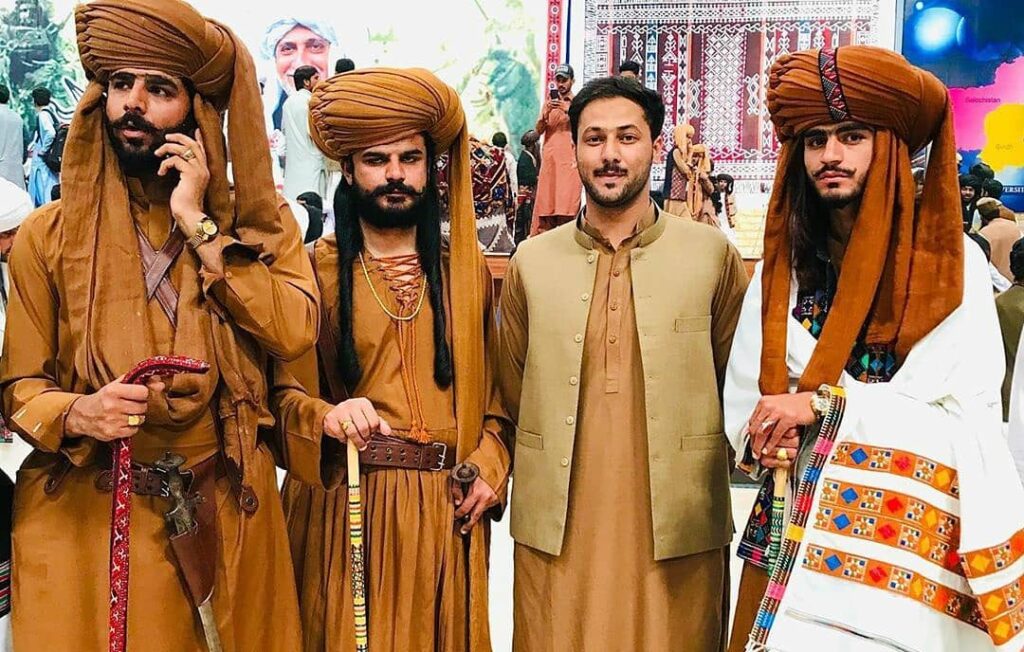
I was born in a village in Balochistan that, in my opinion, was perhaps one of the best places to be born. I grew up in a loving extended family in a small and safe community. Politics was always present in our family life, with history and folklore part of our dinner conversations and bedtime stories. Our family had relatives spread across different parts of Balochistan, on both sides of the border known as the Goldsmith Line dividing Balochistan between Iran (where we lived) and Pakistan.
For me, school was a strange and difficult experience. I could not understand anything the teacher was saying because the lessons were in Persian, not Balochi. I refused to learn this strange language for some time, making school extremely difficult: Until the third grade, I could neither read nor write properly. Then I began to understand my lessons, and by the fifth grade I had become one of the top students in school. This experience deeply influenced my future struggle for the rights of the Balochi language.
When I was in seventh grade, the Iranian Revolution was taking place. Village discussions and the BBC Persian Service awakened my interest in politics and in what was happening in Iran and world. Some of our teachers were also politically active, and they began discussing politics privately with interested students and sometimes even in the classroom.
The Baloch people began asking what the future would hold for them. In this atmosphere, educated Baloch activists, together with those across the border in Pakistan, started organizing demonstrations demanding autonomy for the Baloch people in Iran. People from villages and nearby towns gathered every weekend to demonstrate in different places. We students organized our own protest, demanding proper schools for Baloch pupils. Members of the Islamic Revolutionary Guard Corps came to arrest me as the spokesman, but my fellow students managed to stop them.
I continued protesting while in high school in Chabahar, and I was arrested and held for two weeks as a 14-year-old for reading a resolution at a demonstration against the regime, although thankfully not physically tortured. Future threats of arrest led my father to send me abroad to continue my studies, first to Karachi and then to the United Kingdom.
For me, the freedom of Balochistan has always been a dream worth fighting and sacrificing for. I come from a family with generations of involvement in defending Baloch sovereignty and identity, struggling to achieve Balochistan’s freedom. Growing up surrounded by these stories had a profound influence on my life.
One of the strongest influences was my uncle, Musa Mobaraki, who led the Balochistan Liberation Front against Iranian control over Balochistan, in exile in Iraq. After the 1975 peace agreement between Iran and Iraq, both governments withdrew support for opposition movements and began suppressing them. My uncle was arrested in Iraq, and to this day we do not know what happened to him despite many efforts to find answers.
Before his arrest, my uncle had written diaries describing his plans to send a young Baloch activist to Europe to establish media and advocacy work for the Baloch people, and to combat the repression Baloch endure in Iran. I felt that if I ever had the opportunity, I should continue the work and vision he had been unable to complete.
After working for the United Nations in Pakistan from 1985 to 1987, I moved to Sweden and resumed my education from where it had been interrupted in Iran. Because of my own childhood experiences with language barriers, I became especially interested in linguistics, language rights, and folklore, and I was later admitted to study linguistics at Stockholm University.
In March 1996, a group of activists from different political backgrounds gathered in Stockholm to begin building a broader political movement. We launched a periodical called “Tran,” which means “discourse” in Balochi. The publication became a platform for political discussion and articles on a variety of subjects.
After seven years of discussion and political work, a group of us reached a common conclusion: we needed to establish a political party dedicated to defending the rights of the Baloch people and advocating self-determination within a federal and democratic system. In September 2003, in Stockholm, we successfully founded the Balochistan People’s Party (BPP).
Because the BPP was a well-organized party with contacts and support, the Iranian regime quickly took notice. Only two months after its creation, Iran sent a team of agents to Sweden to gather information about the BPP and particularly about me. The Swedish authorities discovered these activities, and the individuals involved were arrested, but no serious consequences followed for the Iranian government or the agents involved.
The Iranian regime was correct in recognizing the growing influence of the BPP, which has helped to address the lack of international awareness regarding the situation of the Baloch people. We participated in advocacy throughout European and American political institutions and at the United Nations, with particular focus on human rights abuses of Baloch communities in Iran.
Thanks to the efforts of the BPP, Balochistan became a member of the Unrepresented Nations and Peoples Organization (UNPO), further highlighting Baloch grievances internationally. I was elected president of the UNPO four times and served in that position for nearly eight years.
Throughout my life, from a small village in Balochistan to international advocacy platforms, my journey has remained guided by one principle: Every person deserves dignity, justice, freedom, and the right to preserve their identity. My work has always been driven by the hope that the voices of the Baloch people, and all oppressed peoples, will one day be fully heard and respected in the international community.
- Nasser Boladai is Secretary General of the Balochistan People’s Party and a member of the Middle East Minorities Institute Council of Experts.
The views, thoughts, and opinions expressed in this article belong solely to the author and do not necessarily reflect the official policy, position, or views of the Middle East Minorities Institute, its leadership, or its affiliates.