
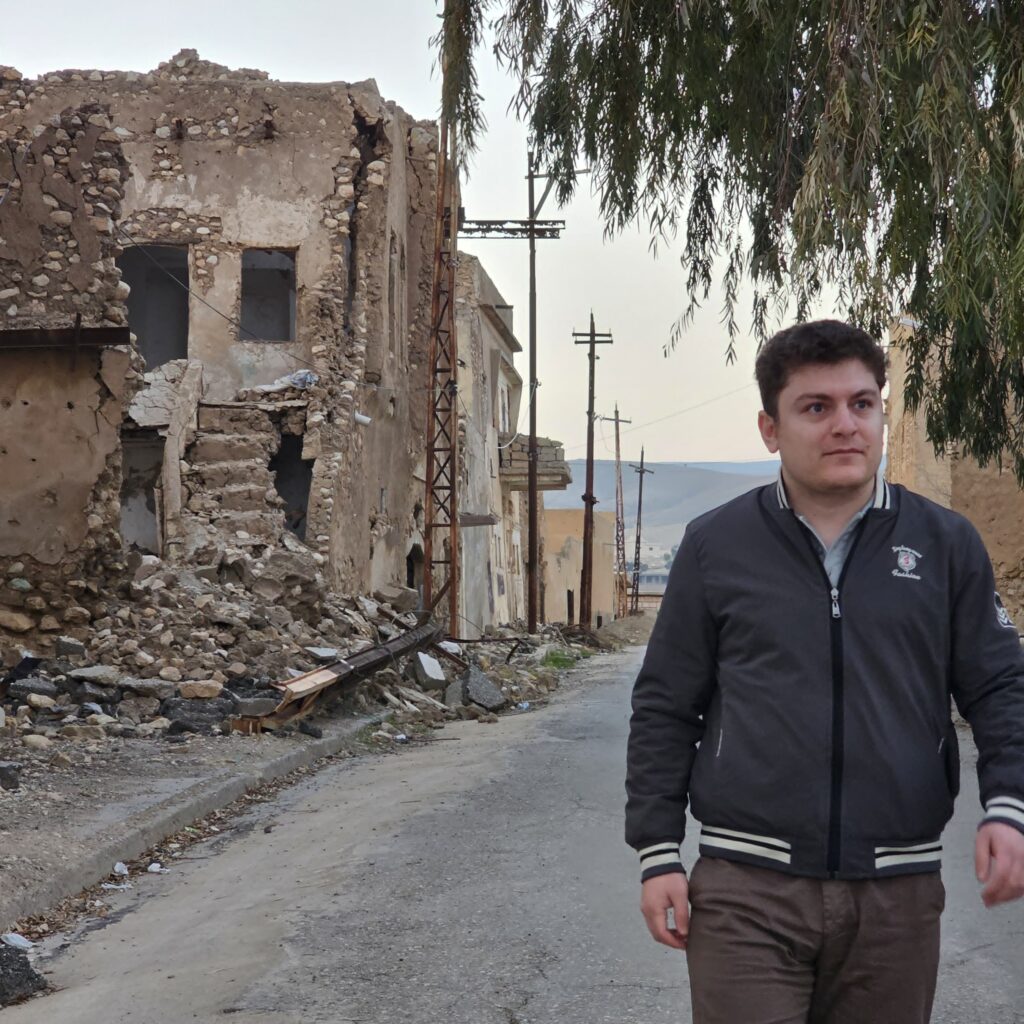
More than 12 years have passed since the Yezidis of Mount Sinjar faced one of the most heinous crimes of the 21st century. My family and I woke up at midnight on our simple rooftop in Tel-Qaseb, Sinjar, Iraq, to the sound of rockets and machine-gun fire as the Islamic State (ISIS) attacked. Little did my 15-year-old mind know that, in just a few hours, we would be on Mount Sinjar, alongside thousands of other Yezidis, trapped by ISIS and left to die in the August heat.
My mother heard from one of our neighbors that the Peshmerga had withdrawn. Never in my life had I heard such terror in a voice as when she told us, “Get your things together, we must escape!” A few hours later, we escaped toward Mount Sinjar in our little green Renault car and our old tractor, alongside several family members. My memory of the thousands of Yezidis running through the summer heat from the village toward the mountain feels like a faded snapshot from a dream. The heat could have fried an egg.
We stopped at our older aunt Mayan’s farm to grab some water. Mayan was like a grandmother to all of us, and we were relieved to learn that she and her family had left before us. We would later receive news that they had been captured by ISIS on their way to the mountain. Although her family later managed to escape, my aunt would be executed alongside other older Yezidi women whom ISIS did not consider suitable for sexual slavery. It took us twelve years of waiting until her body was finally identified and returned. She was buried on October 1st this year.
On our way, we also passed through the mountainside village of Qanê, whose residents shared whatever food and shelter they had. Shortly after we left, the villagers, in their innocence, surrendered their weapons to the terrorists and agreed to their terms. ISIS responded by ruthlessly massacring the men and forcing the women and children into slavery.
Two particular moments during our journey to safety remain in my mind. On the first night, we slept in the southern valley of Mihirkan, where my grandparents had lived in the 1960s. We were trapped in that valley, looking toward its dark entrance, through which ISIS could come at any moment. Our only escape was to climb the rocky mountain toward the north side, where some resistance remained. My uncle Haji knew the brutality of Mount Sinjar and suggested that we leave at two in the morning to avoid, as much as possible, the day’s fatal heat. What I remember most is my sister Aveen lying on the back of our tractor beside our mother and begging her, “Mom, please, don’t leave me in the morning when you leave.” Even 7-year-olds were aware that death was chasing us from all sides and that the world had truly abandoned us.
The other moment I remember is when I felt the same sense of abandonment. It was two in the afternoon. We had just reached the north side of the mountain and were descending through the Kerokh valley. Our water supply was about to run out. The giant, frightening rocks on all sides of the valley, the August heat, and the terrified, hopeless faces of the people made it feel as though we are in an inferno. I remember my idealistic young mind being shattered in that very moment: looking at the sky, hoping to see a plane, hoping for help, and seeing nothing appear. I asked myself, “Where is the international community? What use are they if they cannot save us from a tragedy like this?” That line of questioning has not left my mind to this day.
Since then, a lot has changed in my life. I lived as an internally displaced person (IDP) in Sulaymaniyah, Kurdistan Region of Iraq, for three years. I received a refugee scholarship to the United World College in Italy and completed degrees in Italy and the United States, where I am currently pursuing a PhD.
A lot has changed in the world as well. The Kurdish-led forces in northeast Syria, whose fighters helped save us on Mount Sinjar, have faced renewed fighting and pressure to integrate into the Syrian state. Ahmed al-Sharaa, who led the Nusra Front, formerly al-Qaeda’s Syrian affiliate, became Syria’s transitional president in January 2025 and received congratulations from regional and international governments. To me, this rehabilitation risks whitewashing a violent past, while the suffering of Yezidis remains unresolved.
The Yezidi people, however, have been largely excluded from these changes. Tens of thousands still live in IDP camps in northern Iraq, where fires repeatedly destroy tents during the summer. More tragically, the United Nations reported in August 2026 that around 2,600 Yezidis remained unaccounted for, long after ISIS lost its territorial caliphate.
The work of recovering and identifying the dead is also unfinished. Exhumations have brought some families closer to answers, but others still wait to learn the fate of their loved ones. Further, Sinjar remains contested by armed groups, and insecurity continues to obstruct return. Yezidis also continue to face exclusionary rhetoric and hate speech.
For those who find safety in Western societies, survival brings another question: how to preserve a community across generations. Among my cousins and friends in Germany and elsewhere, I have seen the scars of genocide and the pressures of adapting to a new society. I fear that, without support for healing and cultural continuity, displacement will gradually erode the language, traditions, and shared life that connect us as Yezidis.
Survival cannot be measured simply by the fact that Yezidis are still alive. A community survives only when it can return home in dignity, account for its missing, bury its dead, preserve its culture, and determine its own future. Those conditions have still not been secured for the Yezidi people as a whole. The world failed us on Mount Sinjar, and it continues to fail us by treating our displacement, insecurity, and cultural erosion as a closed chapter. The Yezidi genocide is not merely a tragedy to be remembered; it is a responsibility that remains unfinished. Until Yezidis can live safely, freely, and with dignity as Yezidis, neither survival nor justice is complete.
- Dler Awsman is a PhD candidate at the University of Tennessee, Knoxville, and a Middle East Minorities Institute Council of Experts member.
The views, thoughts, and opinions expressed in this article belong solely to the author and do not necessarily reflect the official policy, position, or views of the Middle East Minorities Institute, its leadership, or its affiliates.